Auxiliary Verb (Group 1) (Basic ㊦ 263)
The first person or someone the speaker empathizes with receives some benefit from an action by someone whose status is not as high as the receiver’s.
Equivalent: Receive benefit from an action by someone; have something done by someone; have someone do something.
| Vて | もらう | |
| 話してもらう | Have someone talk for my sake | |
| 食べてもらう | Have someone eat for my sake |
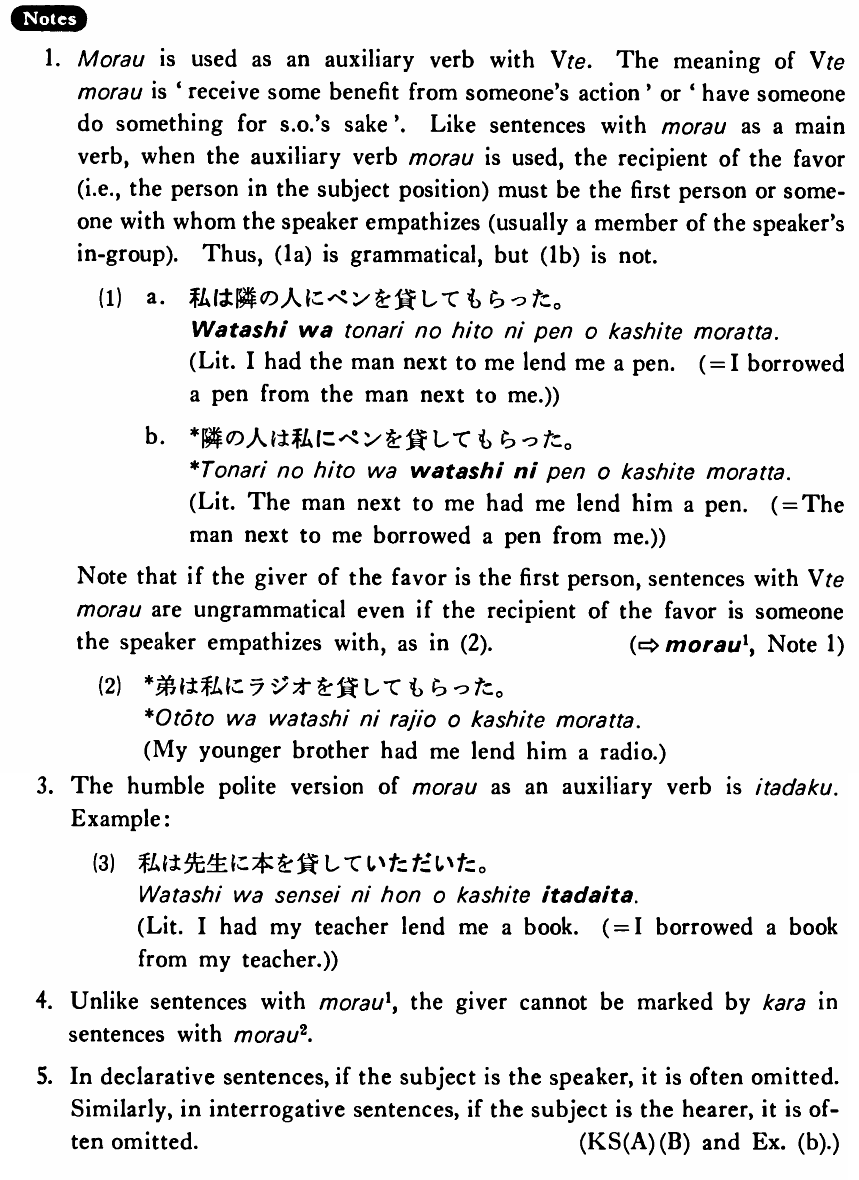
1. もらう is used as an auxiliary verb with Verbて. The meaning of Verbてもらう is 'receive some benefit from someone's action' or 'have someone do something for someones sake'. Like sentences with もらう as a main verb, when the auxiliary verb もらう is used, the recipient of the favor (i.e., the person in the subject position) must be the first person or someone with whom the speaker empathizes (usually a member of the speaker's in-group). Thus, (1a) is grammatical, but (1b) is not.
Note that if the giver of the favor is the first person, sentences with Verbてもらう are ungrammatical even if the recipient of the favor is someone the speaker empathizes with, as in (2).
(⇨ もらう1, Note1)
The humble polite version of もらう as an auxiliary verb is いただく. Example:
4. Unlike sentences with もらう1, the giver cannot be marked by から in sentences with もらう2.
5. In declarative sentences, if the subject is the speaker, it is often omitted. Similarly, in interrogative sentences, if the subject is the hearer, it is often omitted. (Key Sentence (A), (B) and Example (b).)